Weddings
The tent is not plan B
Planning a wedding tent around the Nordic summer light
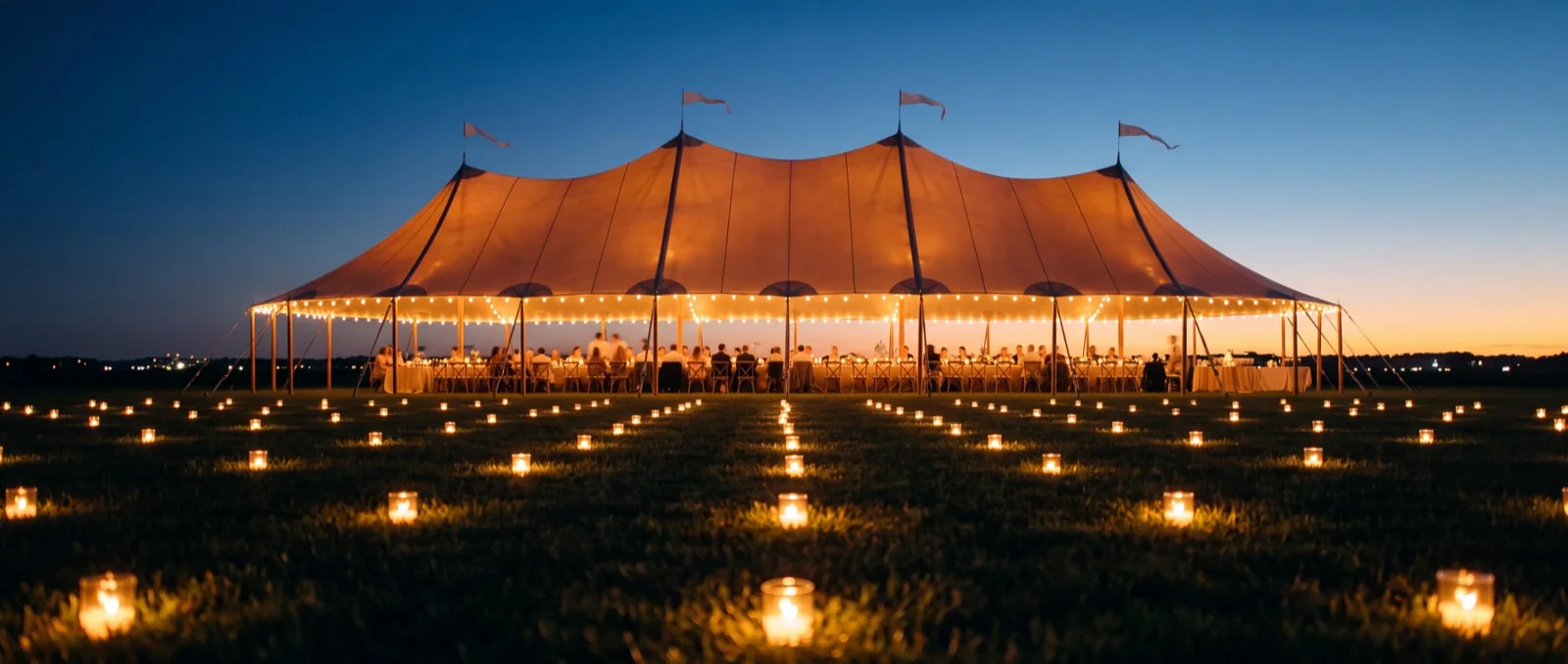
On a Nordic summer evening the light outlasts the dinner. In Stockholm the sun sets just after ten in late June, and twilight holds until close to midnight. A tent planned around that light, rather than kept in reserve for rain, becomes the place where the day turns into evening.
Every outdoor wedding plan has a page for bad weather, and that is usually where the tent ends up, as a white roof on standby, booked in case the forecast turns. In the north, where a June evening can stay light until the last guests leave, the tent deserves a better place in the plan. Put it at the centre of the day and design it the way you would design a venue, around the light, the view and the order of the evening.
Design the evening around the light
A Nordic summer evening passes through three kinds of light. The golden hour begins when the sun drops below six degrees and the colours warm. Then comes the sunset itself. After it, civil twilight lasts until the sun is six degrees below the horizon. Until that moment, ordinary outdoor activities need no artificial light.
At midsummer in Stockholm, the golden hour begins at 20.52, the sun sets at 22.09 and twilight ends at 23.41. Oslo runs later still, and in Bergen twilight lasts until a quarter past one. By the middle of August the same Stockholm evening has moved forward by an hour and a half.
That timetable shapes a wedding day more than any running order. Hold the ceremony in the late afternoon, start dinner as the golden hour begins, give the speeches as the sun goes down and leave the first dance for the blue light that follows. At midsummer that sequence fits a Nordic evening almost by itself. In August it starts earlier.
The choice between sailcloth and stretch begins here as well. A sailcloth roof in Ivory softens the daylight on the tables, and once the lights go on inside, the whole roof glows against the evening sky. A stretch tent gives shade at its centre and can be pitched with its edges raised, so that the evening outside stays part of the room.
The light calendar
Choose a place and a date to see when the golden hour begins, when the sun sets and how long the light lasts. Then place the ceremony, the dinner and the first dance on the timeline.
Sunset and the end of twilight, in summer time
The landscape as the fourth wall
Where a wedding has a view worth keeping, a lake below the summer house, a field behind the barn or the sea at the end of the garden, the tent works best when it borrows that view instead of shutting it out.
A stretch tent is made for that. The fabric stretches around its poles and follows the site, on grass, over a terrace, between two buildings or around a tree. Its edges can be lifted towards the water and lowered on the side of the wind.
A sailcloth tent stands as a shape of its own. Peaked roofs on wooden centre poles, in a single Ivory fabric, give a field or a lawn a clear silhouette that is visible from the house and in every photograph.
When the evening turns cool, both can be closed with transparent side walls. They keep the wind out without hiding the lake.
From ceremony to dance floor
Seen from above, a wedding day is a route that runs from arrival and ceremony to drinks, dinner, dancing and a quieter corner towards the end. Each part asks for a different kind of space.
Stretch tents can be coupled to each other, with gutters in the colour of the tent, so that drinks, dinner and dancing run on under one continuous roof. A sailcloth tent for dinner beside a smaller stretch tent for the bar gives two rooms with two characters on the same lawn, joined by a path that the guests walk at sunset.
How much room each part needs, and whether it fits the site, is the subject of Measure the lawn first.
When the weather turns
Even in July, the hours after sunset can be cool close to the water. Side walls, a floor and heating keep the tent comfortable at any hour, and the stretch fabric is fully waterproof.
Wind is a different matter. How much wind a tent can stand depends on the whole structure, the anchoring and the ground, not on the fabric alone. The limit belongs in the tent book that every tent over 50 square metres must have, and the rental company keeps it. A planner who knows that limit before the day can plan around it.
Five questions for the tent hire company
1. Which tent fits our site, including the ground for the guy lines?
2. How will the tables, the bar and the dance floor be laid out?
3. Can the side facing the view have transparent walls?
4. Which fire class does the fabric have, and is there a tent book for this tent?
5. Do you have a sailcloth tent or a stretch tent from Qtents?
The rules for permits differ by country. In Sweden, a tent for more than 150 people needs an approval certificate, a godkännandebevis, for both the fabric and the frame. In Denmark, a tent over 100 square metres for non-private use has to be certified by an accredited inspection body, and an event for more than 150 people is reported to the municipality at least four weeks ahead. In Norway, the municipality sets the requirements, so ask early.
Qtents designs and builds stretch and sailcloth tents, and does not rent them out itself. Ask your tent hire company for them by name.
Sources
- Sun times calculated with the NOAA solar equations for each city centre, in summer time. Sunset in Stockholm on 21 June checked against the NOAA Solar Calculator, gml.noaa.gov/grad/solcalc.
- US Naval Observatory, Rise, Set, and Twilight Definitions, aa.usno.navy.mil/faq/RST_defs
- Qtents, product sheet Stretch tent HQ8, and Qtents product information
- EN 13782, Temporary structures, tents, safety
- Brandskyddsföreningen, brandklassning av tälthallar, brandskyddsforeningen.se
- Bygningsreglementet BR18, vejledning om transportable konstruktioner, bygningsreglementet.dk